



A French Jewish father and his kippah-wearing son stopped at an Italian highway gas station, only to be accosted by a mob shouting “Free Palestine” and “murderers.” The father stood firm, shouting back, “Am Yisrael Chai.”
Earlier, in a Vienna restaurant, Israeli musicians Amit Peled, Yulia Gurevich, and Hagai Shaham were asked what language they were speaking. Upon answering “Hebrew,” they were promptly expelled, with no one in the restaurant defending them. The day before, a Syrian migrant bit an Israeli tourist on an Athens beach, severing part of his ear.
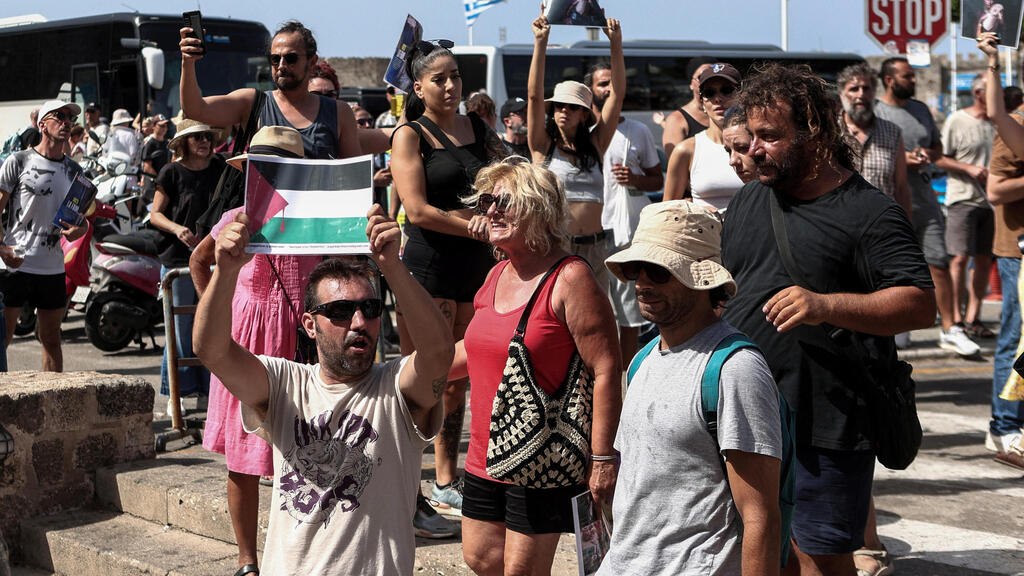
Pro-Palestinian rally in Rhodes near Israeli cruise ship
(Video: Reuters)


Two days earlier, two Israeli teens were brutally beaten in Rhodes and a Mano Maritime ship fled the island of Syros after 100 pro-Palestinian protesters gathered at the dock. At Belgium’s Tomorrowland festival, an antisemitic group linked to Hezbollah “hunted” two Israeli soldiers, accusing them of war crimes.
These six severe antisemitic incidents in a single week underscore a stark reality: Israel is facing a diplomatic tsunami, a storm of hatred, isolation, condemnation and widespread boycotts.
On Monday, pro-Palestinian protesters tried to block a ship carrying Israeli tourists from docking in Rhodes, while the European Commission debated a recommendation to partially suspend Israel’s access to the Horizon 2020 research funding program.
This followed last week’s statements from several EU countries claiming Israel failed to meet its humanitarian obligations in Gaza, urging the Commission to propose concrete measures. Even Germany, a steadfast ally to Israel, supported the move.
The proposal had been expected to be finalized on Tuesday, prompting Israel’s Foreign Ministry to warn: “As Israel battles jihadist terror, such decisions strengthen Hamas and harm ceasefire prospects. Israel will work to ensure the recommendation is not adopted by the EU foreign ministers’ council.”
Horizon 2020, a multi-billion-euro EU framework for research and development, has included Israel as a key partner since the 1990s. A senior Israeli official called potential suspension “a disaster for Israeli science and our image,” warning of a “slippery slope.”
Get the Ynetnews app on your smartphone: Google Play: https://bit.ly/4eJ37pE | Apple App Store: https://bit.ly/3ZL7iNv
Weeks ago, Israel thwarted an EU initiative to suspend trade agreements over alleged human rights violations, but that was before Hamas’ campaign to draw attention to starvation in the coastal strip gained traction, and success this time is uncertain.
Fears are also growing of moves to ban Israel from FIFA, international sports and even the Eurovision Song Contest, potentially placing it alongside Russia, barred from prestigious competitions. Investment in Israel is declining, while academic and cultural boycotts are rising.

Israelis attacked in Rhodes
Criticism of Israel’s alleged “starvation policy” in Gaza spans both sides of the U.S. political spectrum. Diplomatic isolation is intensifying, both in international institutions and bilateral relations. The U.S. has rebuked Israel for unchecked Jewish settler violence in the West Bank.
Democrats, alienated for years, see figures like Zohran Mamdani, a progressive, Israel-critical candidate for New York City mayor, reflecting animosity toward Prime Minister Benjamin Netanyahu, even among American Jews.
Republicans, including Israel’s staunchest allies, also voice concerns over the humanitarian situation. In Europe, momentum for recognizing a Palestinian state is growing, led by French President Emmanuel Macron, who is pressing the UK and Canada to follow. Israel hopes U.S. support will block the move, but success is uncertain.
On Monday, reports emerged that British Prime Minister Keir Starmer plans to propose ending the Gaza war, including recognizing a Palestinian state. Countries like Australia, New Zealand, Portugal and Malta may join France, reflecting both the rising influence of Muslim populations in Europe and frustration over the lack of a political horizon.

Woman accosts a French Jewish man and his kippa-wearing son at an Italian gas station
Dutch Prime Minister Dick Schoof assured President Isaac Herzog he would oppose trade sanctions, yet posted support for them on Monday, sparking an unprecedented clash with Herzog, who criticized a leader of a historically friendly nation.
Israel needs a ceasefire not only to free hostages and ease the burden on IDF soldiers but also to alleviate the international pressure crushing it and Jewish communities worldwide, who bear the cost of global anti-Israel sentiment. Yet Hamas’ impossible demands cast doubt on its desire for a deal.
Israel may lack the luxury of continuing the status quo. Without change, its diplomatic standing will worsen. The humanitarian crisis is Israel’s Achilles’ heel and hopes that the U.S.-backed Gaza Humanitarian Foundation would weaken Hamas have crumbled.
Israel believed denying Hamas aid and distributing it through the fund would force capitulation but Hamas’ starvation campaign, amplified by fabricated images or photos of sick children unrelated to hunger, has resonated globally.
Israel’s repeated failures in public diplomacy have left it both defeated and ostracized.