

While Prime Minister Benjamin Netanyahu’s visit and speech at the UN General Assembly this week will be remembered mainly for the walkout by members of numerous delegations as he began speaking and for the relatively few diplomatic meetings he held during his stay in New York, the Iranian delegation sent to the gathering appears to have had a far busier diplomatic agenda.
Representing Iran at the gathering were President Masoud Pezeshkian and Foreign Minister Abbas Araghchi, who is still in New York and, according to sources, is expected to remain there for the next several days.
(Photo: AP)
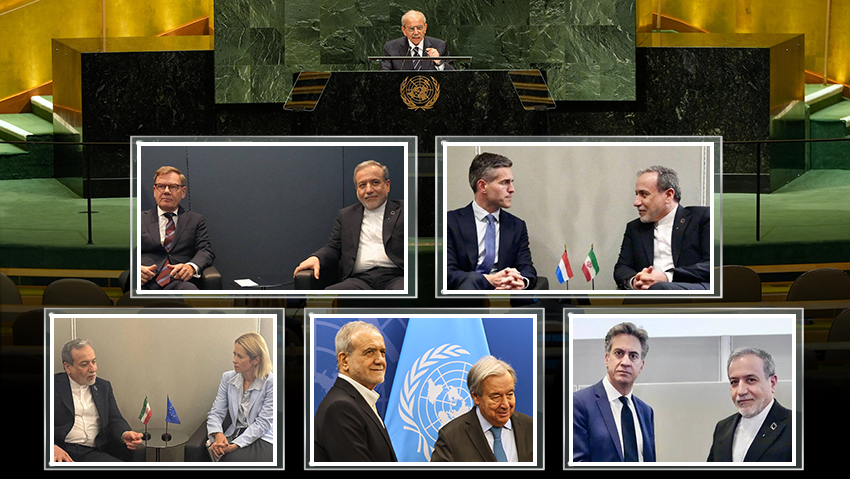
According to a CNN review of Araghchi’s visit to New York, he met with representatives of at least 24 countries, including the foreign ministers of leading European powers. Netanyahu, by comparison, met with nine leaders during the General Assembly, including Argentine President Javier Milei, Greek Prime Minister Kyriakos Mitsotakis and Slovenia’s new prime minister, Janez Janša.
Among others, Araghchi met with EU foreign policy chief Kaja Kallas and his counterparts from Britain, France, Germany, Spain, Portugal, the Netherlands, Poland, Russia and Ukraine. Araghchi also met with his Jordanian counterpart, Ayman Safadi, shortly after Iran attacked U.S. targets on the territory of the Hashemite Kingdom. Iranian President Masoud Pezeshkian met with UN Secretary-General António Guterres and spoke with representatives of Western media outlets.
But the highlight of Iran’s diplomatic activity during the General Assembly was Araghchi’s meeting with Steve Witkoff, U.S. President Donald Trump’s envoy. After the meeting, Araghchi told Western journalists that he had put a new proposal on the negotiating table between Tehran and Washington. Although reports overnight said Trump had rejected the proposal and was preparing for further military strikes, from the Iranian perspective, the significance lay in the fact that the meeting took place at all.
Araghchi also heard tough messages directed at his country in other meetings. According to a BBC report, British Foreign Secretary Ed Miliband told his Iranian counterpart: “The Foreign Secretary reiterated the UK’s unwavering resolve to combat threats from Iranian-linked groups on UK soil, including attacks on the British Jewish community.”
Benjamin Netanyahu at the UN General Assembly
(Credit: UN WEB TV)


CNN, which has been engaged in an ongoing dispute with the Trump administration, wrote of the Iranian delegation’s arrival at the General Assembly: “Seven months after escaping with his life from a U.S.-coordinated Israeli airstrike that killed Supreme Leader Ayatollah Ali Khamenei, Iran’s top diplomat walked the streets of Manhattan this week under the protection of the U.S. Secret Service.”
US economic pressure intensifies
Alongside Iran’s efforts to renew ties with Western countries, Washington appears to be seeking to use additional pressure to deepen Tehran’s isolation. According to a Wall Street Journal report, a senior U.S. Treasury official recently traveled to several countries in Europe and the Middle East that trade with Iran and delivered a message: “You either trade with Tehran or Washington.”
The newspaper noted that in recent days, Iranian airlines have been cut off from vital regional routes while the Islamic Republic’s leading commercial bank has been prevented from conducting transactions in the United Arab Emirates and Turkey. The measures come on top of sanctions imposed on Iran in recent years and the continuing U.S. naval blockade of Iranian seaports.
British lawyer Nigel Kushner, who has advised companies on Iran sanctions for two decades, told The Wall Street Journal that he had never seen such intense pressure brought to bear on Iran’s banking and aviation sectors.
“The U.S. has achieved greater impact in a matter of weeks than during the lengthier campaigns commenced from 2010” he said.
During his address to the General Assembly, Iranian President Pezeshkian acknowledged that U.S. sanctions posed a problem for his country but said they would ultimately have the opposite effect.
“The resistance of the Iranian people will only increase in the face of sanctions, increased pressure, increased bullying," Pezeshkian said. “We will never bow our head or bend at the knee.”