


More than two months have passed since U.S. President Donald Trump announced a two-week ceasefire with Iran, and although relative calm has largely prevailed, sporadic exchanges of fire — particularly over the past week — have repeatedly threatened to spiral into a full-scale war.
Between U.S. strikes, Trump has continued to issue threats against Iran's clerical leadership, while Tehran has responded with warnings directed at Washington, Israel and Gulf states.
US airstrikes in Iran


Over the past week, the United States and Iran have engaged in four separate overnight exchanges of fire. A fifth confrontation also involved Israel after the IDF struck targets in Beirut. Most U.S. attacks targeted Iranian air defense sites and radar systems, while Iran retaliated by striking U.S. military bases in Gulf countries. The confrontation with Israel, which followed an Israeli strike in Beirut, included missile barrages fired at wide areas of the country.
Trump warns: No deal, 'we'll bomb them again tomorrow'
Overnight Wednesday into Thursday, after Trump warned that the United States would hit Iran "very hard," U.S. forces launched a second consecutive night of strikes against targets in the Islamic Republic.
The operation lasted about four hours. U.S. Central Command later said it had targeted military surveillance capabilities, communications systems and air defense sites across Iran.
CENTCOM said the strikes were carried out in response to "Iran's unwarranted and continued aggression."
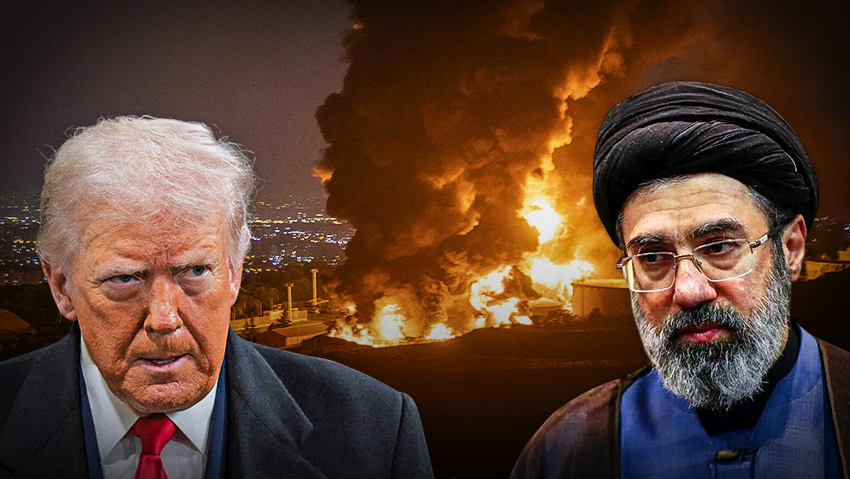
US President Donald Trump, Iranian Supreme Leader Mojtaba Khamenei
(Photo: Anna Moneymaker / AFP, Stringer / Getty Images)
About two hours after the attacks began, Trump told Fox News that if Iran failed to accept the agreement sought by Washington, "we'll bomb the S- out of them tomorrow night."
Iranian officials responded with threats of their own. The Iranian military warned that its armed forces would deliver a "crushing and decisive response" to any U.S. aggression in the region.
Maj. Gen. Majid Mousavi, commander of the Islamic Revolutionary Guard Corps Aerospace Force, said Tehran would "turn the entire region into hell."
"That is the response to American aggression in the region," he said.
Following the U.S. strikes, the Revolutionary Guards announced retaliatory attacks on U.S. military bases in Kuwait, Bahrain and Jordan.
A US warship launches Tomahawk cruise missiles during strikes on Iran
(Video: CENTCOM)
In a statement, the Guards said two waves of attacks hit 18 key U.S. military targets, including Ali Al Salem and Ahmad Al Jaber air bases in Kuwait and Sheikh Isa Air Base in Bahrain.
Iranian state media also reported an attack on the headquarters of the U.S. Navy's Fifth Fleet in Bahrain.
According to the Guards, the attacks were launched in response to U.S. strikes against IRGC facilities, coastal positions, police command centers and areas near Bandar Abbas airport.
Later, the Guards said they had fired 12 ballistic missiles toward U.S. aircraft and military facilities at Jordan's Azraq Air Base, including its command-and-control center.
Kuwait temporarily closed its airspace following the attacks, saying incoming flights had been diverted.
Downing of U.S. helicopter triggers another round of strikes
The previous night also saw exchanges of fire after Iran shot down a U.S. helicopter over the Strait of Hormuz.
"The mission is a proportional response to unjustified Iranian aggression," the command said.
Two hours later, CENTCOM announced the completion of its operation, saying U.S. Air Force and Navy aircraft had used precision-guided munitions to strike air defense systems and radar sites near the Strait of Hormuz.
"U.S. forces remain vigilant and postured to defend against unjustified Iranian aggression," the statement said.
Iran later retaliated with attacks against U.S. targets in the Persian Gulf and Jordan.
Missile exchanges with Israel
Earlier this week, following an Israeli strike in Beirut's southern suburbs, Iran launched 11 missiles toward Israel.
The Israeli Air Force responded by attacking targets in western and central Iran. About 90 minutes later, Israelis awoke to missile alerts warning of launches from Yemen.
Satellite images indicate that an Iranian missile barrage on Wednesday may have damaged a hangar at the Israeli Air Force's Ramat David base
(Video: Soar Atlas)
Iran subsequently launched additional missile barrages in several waves. One strike damaged a hangar at Ramat David Air Base in northern Israel.
In response, Israeli aircraft struck the Karoon Petrochemical Complex in the southwestern Iranian port city of Mahshahr and also targeted Iranian air defense systems.
The attacks in western and central Iran marked Israel's first strikes inside the country since the ceasefire that ended Operation Roaring Lion in early April.
The IDF said several targets inside the Mahshahr petrochemical complex had been hit.
Drones launched at tankers in Strait of Hormuz
Another exchange occurred over the weekend when U.S. forces struck coastal radar facilities in southern Iran after what Washington said was an Iranian drone attack near the Strait of Hormuz.
Iran described the drone launches as warning shots.
After the U.S. operation, the Revolutionary Guards announced attacks on American bases in the region.
Iran said four oil tankers attempting to transit the Strait of Hormuz without authorization had been the intended targets of the drone attack. No casualties were reported.
CENTCOM later said six of seven ballistic missiles launched toward Kuwait and Bahrain had been intercepted, while the seventh failed to reach its target.
In an interview with NBC, Trump claimed that most of Iran's drone factories, launchers and missile stockpiles had been destroyed during the war.
"They have some missiles, they have some drones," Trump said. "I would say percentagewise, maybe 21%-22% of their missiles. It’s a lot of missiles, but it’s not what it was when we first attacked."
Competing narratives over who struck first
Last week, sirens sounded in Bahrain and Kuwait about an hour after the United States announced a strike on an empty oil tanker in the Strait of Hormuz that was heading toward an Iranian port.
The Revolutionary Guards claimed responsibility for missile and drone attacks against U.S. bases in the Gulf.
Footage of strikes on radar sites in southern Iran
(Video: CENTCOM)
CNN described those exchanges as the largest attacks in weeks, raising doubts about the durability of the ceasefire.
According to the Guards, the confrontation began after a U.S. strike on Qeshm Island in the Persian Gulf. Washington said its attack was itself a response to earlier Iranian actions.
The U.S. military confirmed striking Qeshm Island but said Iran had fired first.
According to the U.S. account, Iran launched five ballistic missiles toward neighboring countries — three toward Bahrain and two toward Kuwait. U.S. officials said the missiles aimed at Bahrain were intercepted and those headed for Kuwait broke apart before reaching their targets. The military also said it intercepted three drones.
In a statement, the Revolutionary Guards said that "in response to aggression against the oil tanker, naval forces of the IRGC attacked the American-Israeli enemy vessel Panaya with missiles."
The statement added that after a subsequent U.S. strike on an IRGC communications tower on Qeshm Island, Iran retaliated with missile and drone attacks against an air base in a regional country and against the headquarters of the U.S. Fifth Fleet.
"We warned previously that any aggression would be met with a different and much harsher response," the statement said. "That is exactly what we did."