

Foreign Minister Gideon Saar acknowledged in a closed conversation on Tuesday that Israel will not advance moves to apply sovereignty or annex parts of the West Bank because U.S. President Donald Trump opposes such steps. In recordings from a briefing with members of American Friends of Likud obtained by ynet, Sa’ar is heard saying that “implementing sovereignty we will need to do only with the coordination with the United States of America.”
Gallery
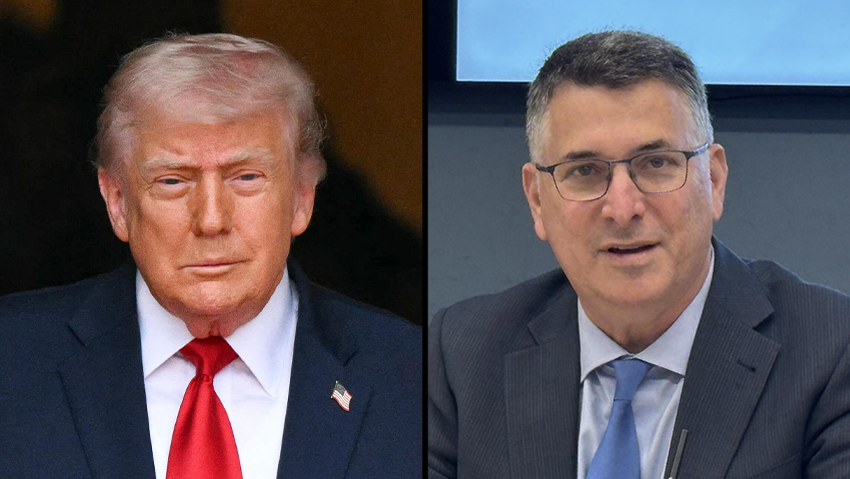
US President Donald Trump; Foreign Minister Gideon Sa'ar
(Photos: Gil Yohanan, Mandel Ngan / AFP)
According to Sa’ar, “we don't have intention to do it, at least in the coming months, it is against the path of President Trump's plan, and doing that will no doubt alienate Israel from a lot of friends.”
At the same time, Sa’ar made clear that Israel opposes a Palestinian state and is advancing measures on the ground in the settlements. That is “one of the reasons why we have tension in our relations with the EU,” he said.
"We oppose the Palestinian state and they think, and as a matter of fact, there is something to it, our settlement policy is not totally connected with the will or wishes about the future of Judea and Samaria," he added, using the biblical term for the territory of the West Bank.
Sa’ar’s remarks mark a clear official acknowledgment by a senior government minister that the main reason Israel is currently refraining from advancing sovereignty in the West Bank is not an internal Israeli consideration, but the position of the Trump administration.
The data is 'not logical'
Referring to recent political developments in Israel, Sa’ar estimated that elections will be held on schedule. “We are in an election half year, because elections will be not after October 27,” he explained.
He dismissed polls showing a defeat for the right-wing bloc, calling the data “not logical” because they underestimate the demographic strength of the ultra-Orthodox.
"I don't think that the polls of the left-wing channels are right, and I can see certain places which are not logical,” Sa’ar said, adding that in the polls of the right-wing channels, the right-wing bloc wins.
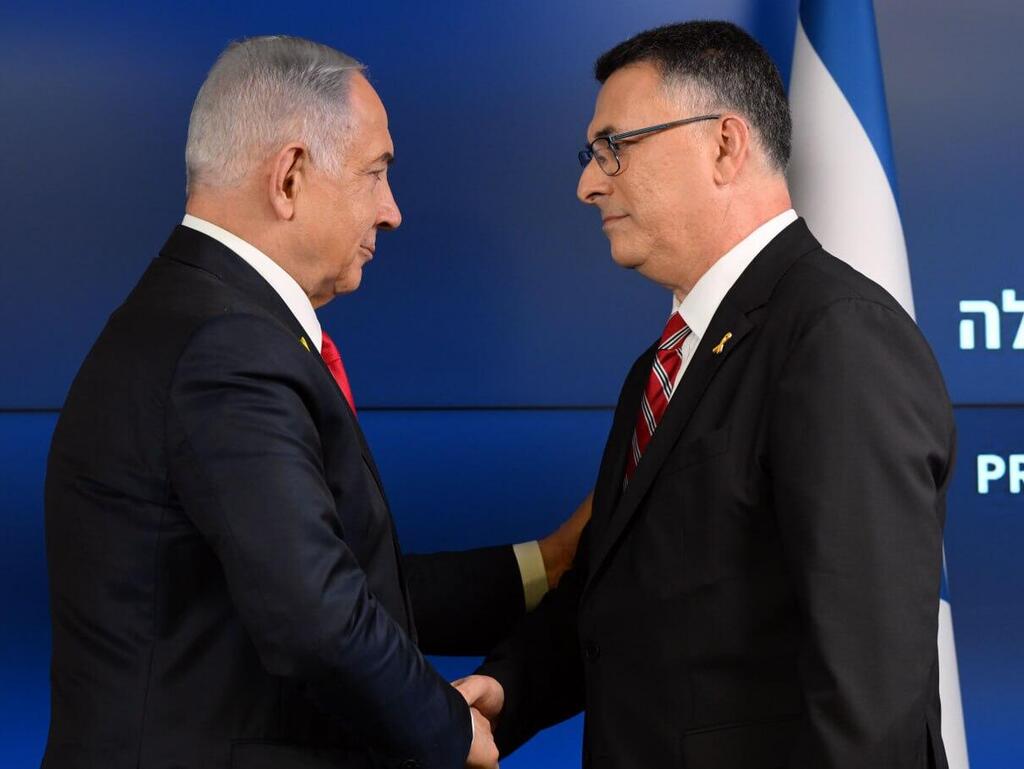
Gideon Sa'ar said he joined Benjamin Netanyahu's government so the PM could 'concentrate on meeting the challenges'
(Photo: Haim Zach, GPO)
"If I will take, for example, the five TV channels, we have 11, 12, and 13, which are, to say the least, leaning left channels, and in their polls we are losing the elections. But channel 14 and channel 15, which are, as you know, right wing channels in their polls, including this week, we are winning the elections. So the question is, really, who is publishing the right polls? And I cannot give you an accurate answer on that."
Still, the minister acknowledged that the ruling party had lost votes among immigrants from former Soviet Union countries, adding that “this could lead to a national unity government in the next Knesset.”
Regarding his decision to join the government, Sa’ar said it was “the most important decision of my political career.” He said the move was intended to stabilize the political system and strengthen Prime Minister Benjamin Netanyahu so he could "concentrate on meeting the challenges which was heavy and still are complicated."
On the bill exempting ultra-Orthodox men from military service, Sa’ar said it is an emotionally charged issue, and therefore the prime minister would not try to resolve it before the next election. The foreign minister expressed doubt that legal measures or economic sanctions would lead to ultra-Orthodox enlistment, stressing that the solution requires coordination with rabbis.
He argued that it would be better to "deal with it more quietly and more reasonably, after the next elections" rather than now, when the matter is being used by politicians seeking to garner votes.
“I doubt whether legal steps or social confrontation will bring the ultra-Orthodox to the army,” Sa’ar said. “Some people say, ‘What will bring them is economic sanctions.’ Well, I don’t know, maybe a certain portion. But I believe the solution will be coordinated with that world, with the rabbis, with the political forces, even if it is gradual, even if it is partial, even if it is a step-by-step approach — but it is a solution.”
‘The program was immune to an air force strike’
Regarding the war with Iran, Sa’ar said that contrary to Trump’s statements the ayatollahs’ regime has not resumed uranium enrichment since Operation Midnight Hammer in June 2025. However, Sa’ar made clear that Israel does not want to find itself in a new war every year, and that it chose to go to war because Iran intended to move its nuclear program deep underground.
"Before this war, we saw they intend to move to very deep underground their nuclear program. And there, this program was immune from an attack of our Air Force, or the American Air Force. So that was a time we had to make decisions, and we didn't really have better choices," Sa'ar said.
According to the foreign minister, toppling the regime in Tehran was not a declared goal, but rather removing "existential threats" from Iran against Israel for as long as possible. He acknowledged that Israel wanted to create conditions that would lead to that, but said it does not depend on Israel.
"We knew that the question of the regime change is not eventually in our hands. Iran is bigger 75 times than Israel. We didn't have a plan to invade or conquer, to invade or to conquer all of Iran in order to in order to achieve that, and eventually it's in the hands of the Iranian people,” Sa’ar said.
He added that if a clear opportunity emerges to push for regime change, Israel will act to make it happen.
"Iran is economically, severely damaged. We we cannot predict what will be the consequences. But just a reminder on last December, that was the reason why people went into the streets, and eventually, I think, economic pressure from inside, and we know it's something that bothers very much the Iranian regime, but they are locked in their fanatic, extremist policies with not much flexibility, so they don't want the war to be returned. They don't want to see that, but at the same time, they don't want to make any substantial compromises on nuclear so I don't know to predict when and if it will happen, but if we will see an opportunity clearly, we would push that it will happen," he said.
Sa’ar confirmed that there are disagreements with Trump on the issue, but stressed that “in the big picture, we see things eye to eye.”
The foreign minister also addressed reducing Israel’s dependence on U.S. security aid, saying it could happen faster if circumstances require it. “Ultimately, the prime minister himself understood that over time we need to change the current situation, and we think we can do it. And if there are circumstances in which we need to do it faster, we will do it faster. I hope that will not happen.”
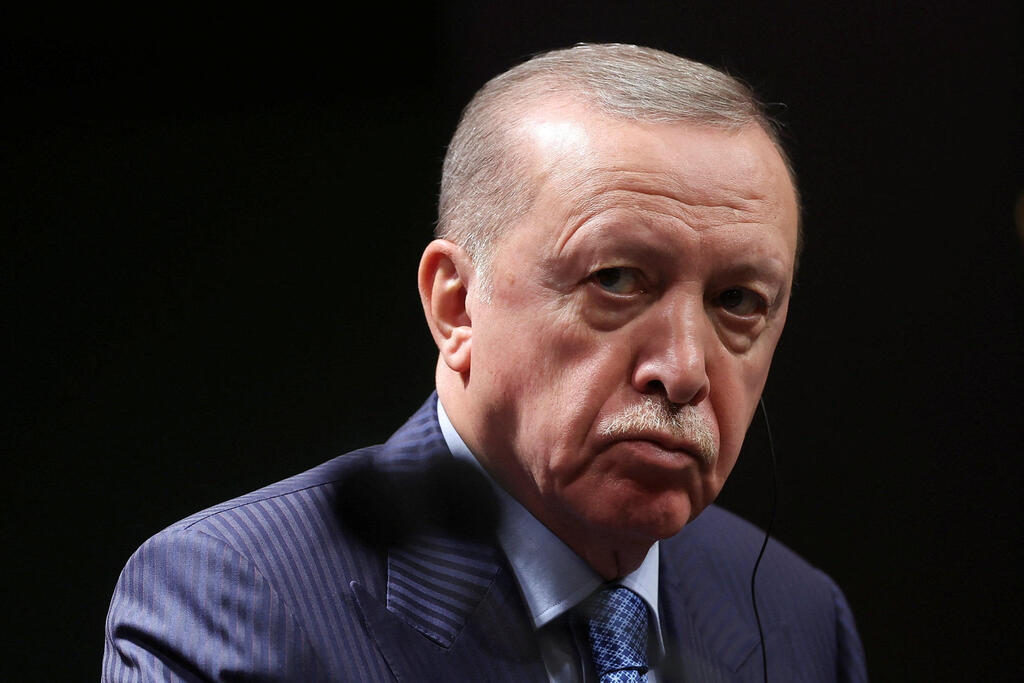
Turkey's Erdogan 'wants to be a regional leader'
(צילום: REUTERS/Umit Bektas)
Sa’ar also addressed Turkey’s involvement in the region, saying that under Recep Tayyip Erdogan’s rule, the country has gone from a friend with good relations and the “number one destination for Israelis to go on vacations” to a country “very hostile to Israel.”
“Erdogan wants to be a regional leader," Sa'ar said, adding that Turkey has "aspirations."
"They once were an empire, and they have a very aggressive policies of having influence, not only in our region, the Middle East, also in the Balkans, in Africa, in Asia," he said.". We are not looking for deterioration with Turkey, but Erdogan is working on that for himself.
He noted that part of Israel’s motivation for operating in southern Syria was to prevent Syria from becoming a "Turkish protectorate and to have a border with Turkey.”
Sa’ar also addressed relations with the Kurds in Syria, saying Israel maintains good ties with them through their representatives, but clarified that “we don't have the same commitments which we have to the Druze, which are, as you know, alsoa minority in Israel, serving in the IDF. They are very loyal and good warriors, and therefore our reaction was different when they try to massacre the Druze."
Sa’ar said Israel had tried to help the Kurds, but acknowledged the limits of its influence. “There are things that happened that we were not happy with, but could not change, for example the American decision to leave Syria,” he said. “They are the largest people in the world, clearly in the Middle East, without independence. We wish them the best, but I don't think that the current regime in Syria has a real intention to tolerate them as national minority, to give them rights to work fairly with them. It's basically jihadists that are the political base of Al-Sharaa."
Challenges with ‘left-leaning governments’
Contrary to concerns about international isolation, Sa’ar said he is not worried that Israel will become like South Africa once was. “We still have friends today," he said. "During this war, we expanded our foreign relations. We opened new embassies, we even began new diplomatic relations."
The foreign minister acknowledged, however, that there are challenges with “left-wing governments,” noting that while Israel’s close friends were once in Western Europe, today its main support comes from countries in Central and Eastern Europe.
According to him, threats of sanctions against Israel have been raised again and again — “and this is still continuing” — but they have repeatedly been blocked with the help of Israel’s friends in the EU.
"Our best friends are from the center to the east in Europe. In the east, from the Balkans to the Baltic states, in the center countries like Czech Republic Hungary. Germany is quite good from the strongest countries, but they were also in the previous decades. But other countries which were more close, like the United Kingdom or France or the Netherlands, clearly, Belgium today,the feeling of partnership with them almost does not exist."
According to Sa’ar, Israel's "number one problem is not the diplomatic situation, but the public opinion situation, and this is our main challenge. We are also working on how to significantly improve our performance on that. But I would say, when you have a very long war, it creates a very difficult situation."