

The year 2026 is expected to be the first in three years in which Israel is not formally at war. Yet the calm that prevails for now, achieved at the cost of the blood of more than 2,000 soldiers and civilians, may prove temporary. In the north, the south and beyond Israel’s borders, the winds of war are still being felt. Hezbollah has not disarmed, Hamas is unwilling to do so, and in Iran, according to reports, preparations are intensifying for the next confrontation with Israel after the painful defeat Tehran suffered last June.
In Israel, the prevailing concept that existed before October 7, 2023, no longer holds sway at the political and military levels. There is now a belief that every threat must be neutralized before it becomes existential. The result, many argue, is almost inevitable: further fighting is only a matter of time.
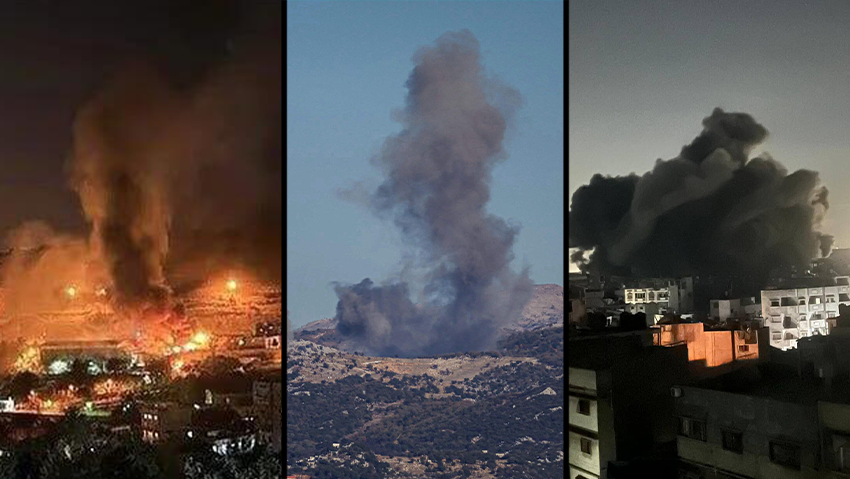
The northern front
At the end of 2025, the deadline set by Washington and Jerusalem for Hezbollah to disarm south of the Litani River expired. The task was not completed. The Shiite terrorist organization still retains weapons and forces and is in the process of rebuilding. Several weeks ago, Israel made clear it might be forced to launch another military operation against Hezbollah’s rehabilitation efforts, while simultaneously increasing strikes on operatives and weapons stockpiles. Since then, however, tensions have eased somewhat.
Despite the failure to achieve the goal, the Hezbollah issue received only marginal attention during the meeting between Prime Minister Benjamin Netanyahu and U.S. President Donald Trump at Mar-a-Lago. The likely reason is that the two leaders see eye to eye on the matter, with neither side seeking the collapse of the ceasefire. Netanyahu has also toned down his rhetoric, describing Hezbollah in an interview with Fox News as “a shadow of its former self.”
For their part, the Americans intend to allow Israel to continue striking in Lebanon, but apparently without “breaking the rules.” At the same time, they believe Lebanon’s government should be given another chance to strengthen itself vis-à-vis Hezbollah, and they are banking on that process. Here, however, a dispute exists between the United States and Israel: Jerusalem acknowledges the good intentions but argues that Lebanon lacks the capacity to disarm the terrorist organization.
About a month ago, Hezbollah Secretary-General Naim Qassem warned that the group would ultimately respond to Israeli strikes. If and when that happens, the war in the north could resume. In Lebanon there is already concern that Trump has given Israel a “green light” to act, while Hezbollah-affiliated media outlets say it is “unclear what kind of escalation Israel will pursue and on what scale.”
A weak, fearful and threatening regime
Beyond the Lebanese threat, the Iranian threat still looms. In recent weeks, and more intensely as Netanyahu’s meeting with Trump approached, reports have multiplied about progress in Iran’s missile program and preparations in Tehran for another campaign. Security officials seeking to calm the atmosphere have also warned of a “miscalculation” scenario, in which Iran might strike first out of fear that Israel is about to attack.
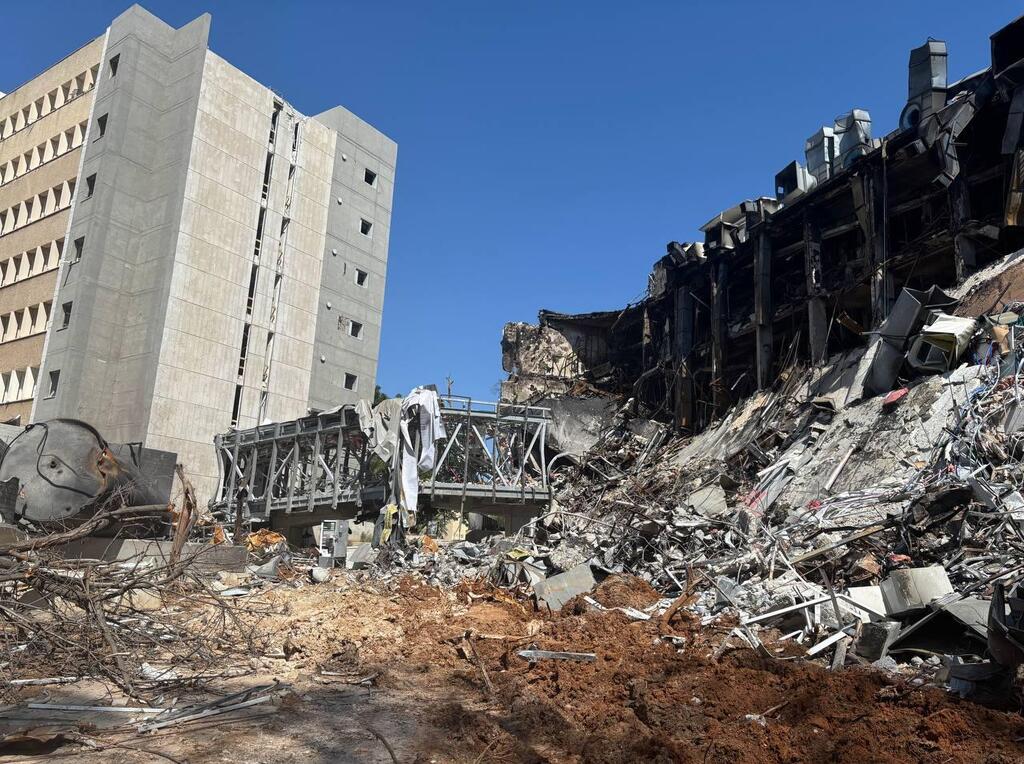
An Iranian missile struck the Weizmann Institute
(Photo: Meir Turgeman)
For now, the IDF Spokesperson’s Unit has said there are no changes in force readiness or Home Front Command guidelines. On the ground, across Israel, the destruction from Iranian missile strikes in the last round in June is still visible, much of it untreated. This is not limited to major sites such as the missile strike on Soroka Medical Center or the direct hit on the Weizmann Institute; private homes have not been fully repaired, apartments remain ruined and collapsed buildings have yet to see reconstruction begin.
At Mar-a-Lago, Trump gave what amounted to a green light for the IDF to strike Iran if no agreements are reached on its missile program, which Israel views as an existential threat even if Tehran does not reach a nuclear bomb. Iran, significantly weakened since October 7, 2023, still maintains effective proxies in Lebanon, Iraq and Yemen, and is extending its reach to additional countries in an effort to tighten the noose around Israel once again.
At the same time, Iran’s regime is in poor shape. Security officials assess that it is unlikely to launch an attack in the near term and warn against irresponsible statements. Commentator Nadav Eyal wrote in Yedioth Ahronoth two weeks ago that, beyond the water crisis, the Iranian rial has repeatedly hit record lows. Recently, under pressure, the government in Tehran canceled small fuel subsidies.
Footage of protesters attacking the provincial government building in Fars Province, Iran


Preparations were frantic: Iranian opposition websites reported that Tehran mobilized all its forces, from police to the Basij, to ensure the subsidy cancellation, a financially minor event, would not spark a popular uprising. The regime’s condition is dire by any measure. If there is a large clock in Tehran counting the hours and days to Israel’s destruction, in parts of Israel analysts are measuring the Iranian regime’s stability indices, which have recently hit a low point.
Anyone who wants to fantasize about the fall of the ayatollahs’ regime can do so. It has never been weaker or more fearful, at least since 2009, and at times appears too weak even to enforce modesty rules on women. Strategically, according to Eyal, this is a welcome development that could herald regime collapse, though it is not advisable to hold one’s breath. In the short term, however, it is a major headache. A wounded, bleeding regime may sprint toward a bomb, or toward war.
Iran’s Supreme Leader Ali Khamenei warned Wednesday that “military action will exact a heavy price.” In a statement from Khamenei’s communications office, officials mocked the tough statements heard at Mar-a-Lago and warned that “every additional act of foolishness will carry a different price than the previous one. The United States continues its policy of intimidation. If the American administration were wise, it would understand that it cannot address the Iranian people in the language of force and threats. Our forces are on high alert. They have drawn the lessons of the 12-day war.” These remarks were echoed by Iranian President Masoud Pezeshkian, who said that “the response to any aggression will be harsh and will make you regret it.”
Gaza and other arenas
In the Gaza Strip, there is broad agreement that if Hamas does not disarm, Israel will do it for them. This has delayed the establishment of an international stabilization force, the transition to Phase II of the agreement, and the return of the body of the captive soldier Ran Gvili. For now, no deadline has been set for Hamas, but timetables appear to be shortening and aligning more closely with Israel’s preferences rather than those of Turkey and Qatar. Israel warns of what it sees as Hamas dragging its feet, with the backing of its patrons, in order to allow the terrorist organization to rebuild its strength. Meanwhile, the Americans are not allowing Israel to “break the rules” here either, and the IDF strikes only when Hamas violates the ceasefire.
There is also no agreement between Israel and the United States regarding Turkish involvement in Gaza. Although it was agreed that there would be no Turkish troops in the stabilization force, Washington insists that Ankara be given a role in reconstruction efforts, despite President Recep Tayyip Erdogan being one of Hamas’s most prominent supporters worldwide, alongside Qatar.
Beyond all this, Israel is also likely to face the issue of the Houthi regime in Yemen, which has not abandoned its murderous, anti-Israel ideology. Recently, the IDF trained for a scenario involving a Houthi incursion from Jordan, and has established brigades dedicated solely to Yemen.
There is also the Syrian regime, which is conducting behind-the-scenes talks on a security agreement with Israel that have yet to mature. IDF forces remain deployed along the border beyond the Golan Heights to protect Israeli communities “from the front.” Syrian leader Ahmed al-Sharaa has said on the one hand that Israel must withdraw, but on the other that he will not initiate any offensive action against Israel that would endanger Syria. For now, Israel is not acting against him as long as the safety of Syria’s Druze population is assured.