


The political landscape of the Middle East is undergoing a profound and dangerous transformation. Following the collapse of Bashar al-Assad's dictatorship in December 2024, a highly volatile and unpredictable security dynamic has emerged along Israel’s northern frontier.
Behind the scenes of this chaotic regional transition, cold strategic calculations are overriding historical rivalries and traditional political dogmas. On 14 August 2026, Mossad Director Roman Gofman conducted a direct telephone call with Syrian Foreign Minister Asaad al-Shaibani to address the rapid and alarming expansion of Turkish military assets inside Syrian territory.
Gallery
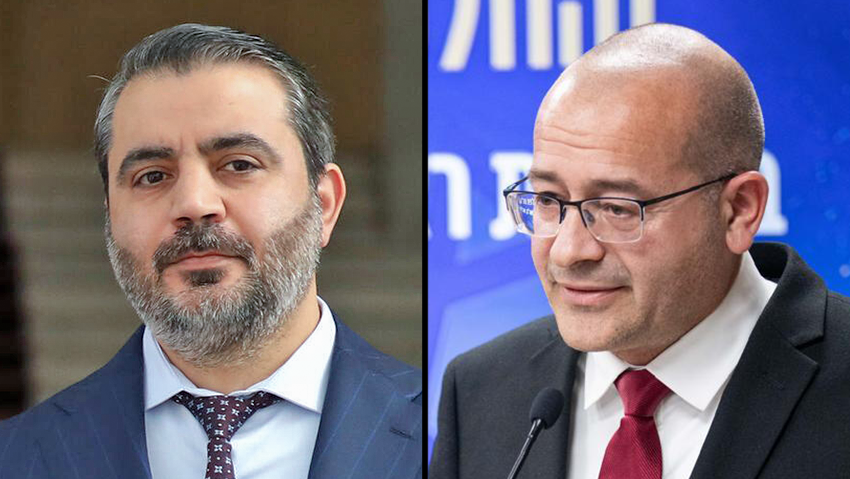
Syrian Foreign Minister Asaad al-Shaibani and Roman Goffman
(Photo Ali Haj Suleiman/Getty Images; IDF Spokesperson)
This contact represents one of the highest-level direct communications between Israeli and Syrian officials since the fall of the Assad regime. It demonstrates a rare and compelling geopolitical reality on the ground.
While Israel and Syria remain separated by deep historical divides, both nations are navigating a shared geopolitical pressure driven by foreign imperial ambitions and internal instability. For Israel, this shadow dialogue is not an attempt to forge a formal alliance or a sentimental peace treaty, but rather a pragmatic exercise in interest-based diplomacy designed to safeguard national security, protect territorial integrity, and prevent dangerous regional actors from permanently altering the balance of power in the Levant.
At the core of Syria's political evolution stands the complex and risky leadership of Ahmed al-Sharaa, a figure whose recent attempts at international respectability cannot erase a long history of jihadist extremism.
Formerly known by his nom de guerre Abu Mohammad al-Julani, Sharaa commanded designated terrorist organizations including the al-Nusra Front and Hay'at Tahrir al-Sham, maintaining historical links to al-Qaeda that earned him an official United States terrorist designation.
Although Sharaa has traded military fatigues for tailored Western suits and adopted the language of political statecraft, Israel must view his governing apparatus through a lens of profound security skepticism.
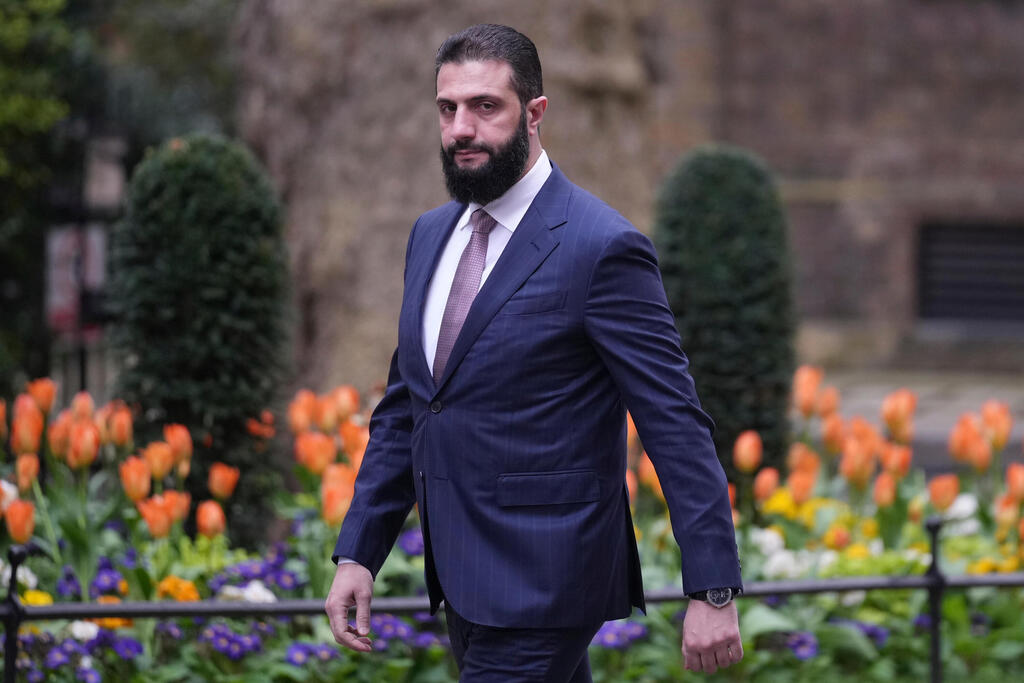
Sharaa has traded military fatigues for tailored Western suits and adopted the language of political statecraft
(Photo: Alastair Grant/AP)
From a rigorous national security standpoint, ideological foundations and historical trajectories demand a hard-nosed assessment rather than hopeful assumptions. Caution and non-naïveté are paramount.
Short-term tactical moderation does not eliminate the severe structural risks inherent in an Islamist-dominated authority operating directly on Israel's northern threshold. History demonstrates that extremist movements frequently utilize temporary political pragmatism to secure foreign legitimacy and consolidate domestic power.
Israel cannot afford to build its defensive posture on wishful thinking, and it must treat the new governing structure in Damascus as an enduring security variable requiring constant vigilance.
While radical Islamism poses an insidious long-term concern inside Syria, the immediate geometric shift in regional power is being driven by the expansionist military posture of Turkey.
Under President Recep Tayyip Erdoğan, Turkey has systematically projected imperial influence deep into Syrian territory. Turkey maintains a substantial and expanding military footprint numbering in the thousands to tens of thousands of troops and security personnel across more than one hundred bases, outposts, and observation points.

Syrian interim President Ahmad al-Sharaa, Turkish President Recep Tayyip Erdoğan
(Photo: AL ARABIYA TV/Handout via REUTERS, Andrew Harnik / GETTY IMAGES NORTH AMERICA / AFP)
Open-source mapping indicates approximately 126 Turkish sites distributed across northern and central Syria. Through recent security agreements signed with the new administration in Damascus, Ankara has consolidated its operational positions and initiated expansive programs to train and equip Syrian military and security forces.
This institutional integration grants Turkey unprecedented leverage over Syria's internal security architecture and political destiny.
For Israel, Turkey’s growing military footprint represents a direct and formidable strategic challenge. Turkey is a major power possessing advanced aviation capabilities, electronic warfare systems and modern air defense networks.
If Turkey converts central and southern Syria into a permanent platform for military projection, Israel’s vital operational freedom in northern airspace will face unprecedented restrictions.
Confronting localized militias is vastly different from operating near the integrated defense assets of an assertive regional military power. Once a foreign power hardens its installations inside Syrian territory, reversing that footprint without triggering a broader confrontation becomes extraordinarily difficult.
Israel cannot permit any external actor to construct offensive infrastructure that degrades its strategic depth or restricts its capacity to neutralize emerging threats to its northern communities.
This mounting strategic pressure explains the pragmatic communication between Jerusalem and Damascus. The phone call between Mossad Director Roman Gofman and Syrian Foreign Minister Asaad al-Shaibani on 14 August 2026 reflected a mutual recognition of the risks posed by unchecked Turkish expansion.
For Syria, struggling to rebuild state authority while facing economic devastation, total dependence on Ankara threatens national sovereignty and territorial control. Discrete communication with Israel offers Damascus a subtle counterweight against being entirely absorbed into a Turkish sphere of influence.
For Israel, this backchannel dialogue provides essential real-time intelligence regarding Turkish military deployments and proxy movements along the frontier. This dynamic does not constitute a secret alliance, but rather a cold, overlapping alignment of immediate self-interest.
The necessity of backing shadow diplomacy with decisive kinetic force materialized on 18 August 2026, when Israel executed eight precision airstrikes targeting the strategic Abu al-Duhur military airbase in northwestern Syria.
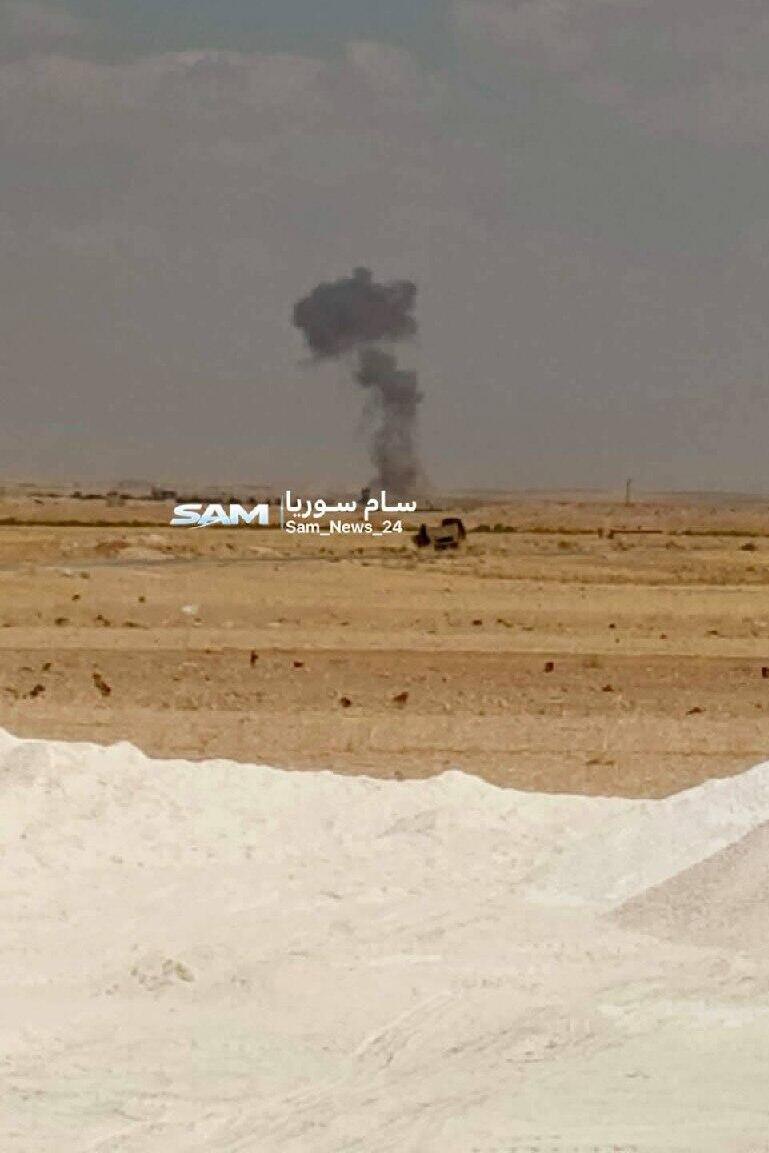
Reported IDF strike in Syria
The strikes focused specifically on neutralizing the airbase's primary runway and military storage infrastructure. Strikingly, the attack took place just hours after a Turkish military delegation had visited the base to inspect facilities and assess operational capabilities.
Following the operation, the Israeli Prime Minister’s Office issued an explicit statement declaring that Syria was on the verge of breaching an agreed security status quo by allowing a Turkish military deployment at the base.
The statement emphasized that Syria had chosen to ignore repeated Israeli warnings, making it clear that Israel will not tolerate any military presence along its border that threatens its national security.
The strike provoked immediate international reaction and diplomatic maneuvering. U.S. Special Envoy Tom Barrack publicly criticized the Israeli airstrikes as an unnecessary escalation, revealing that Washington is actively working to establish a formal de-confliction mechanism among Israel, Turkey and Syria to manage regional friction.
While diplomatic coordination with the United States remains an essential pillar of Israeli foreign policy, Israel cannot rely solely on external diplomatic mechanisms or foreign guarantees when its core national security priorities are at stake.
A formal de-confliction framework cannot replace independent military deterrence or restrict Israel's right to act against emerging threats.
Understanding Israel's security posture requires abandoning simplistic political narratives. The region operates on raw power dynamics, rapid shifts in self-interest and uncompromising deterrence.
Western hopes that post-conflict governance under Ahmed al-Sharaa will automatically yield democratic stability must be tempered by a realistic assessment of ideological history. Likewise, Turkish expansionism cannot be ignored out of deference to broader diplomatic alliances.
Israel’s primary strategic duty is the protection of its citizens and the preservation of its national sovereignty, an obligation that demands relentless vigilance, flexible shadow diplomacy and a readiness to strike independently whenever red lines are threatened.
As the geopolitical map of the Levant continues to be rewritten, Israel stands as a fortress of stability and strength.
The pragmatic intelligence dialogue with Syria, paired with aggressive kinetic deterrence against Turkish expansion and radical Islamism, reflects a security doctrine that is proactive, realistic and unyielding.
Strategic mastery lies in identifying emerging dangers early, exploiting regional divisions and maintaining overwhelming operational dominance. By refusing to permit foreign military bases on its northern perimeter and remaining clear-eyed about the ongoing risks of radicalism, Israel ensures its freedom of action and long-term security.
Amine Ayoub, a fellow at the Middle East Forum, is a policy analyst and writer based in Morocco. Follow him on X: @amineayoubx