


With the European Union unable for months to reach consensus on sanctions that would ban imports from Israeli settlements, several European countries have begun pursuing restrictions independently, moving the issue from EU-wide diplomacy to national legislatures.
The lack of consensus in Brussels has led governments supporting such restrictions to conclude that each country must pass its own legislation if it wants to prohibit settlement imports.
British Foreign Secretary Ed Miliband announces sanctions of Israeli settlements in West Bank
(Video: UK Foreign, Commonwealth and Development Office)


The Netherlands has already adopted such measures, although the Dutch order has been challenged in court on claims that it is discriminatory. It is scheduled to take effect Sept. 22.
Belgium has announced plans for similar action but has not yet enacted legislation, meaning no restrictions are currently in force there.
Spain already has legislation in effect, although Israeli exports to the country from the West Bank are limited. Similar legislation is now being discussed in Luxembourg, while Sweden is pursuing its own process.
The addition of more countries supporting restrictions has caused significant concern in Israel — not primarily because of the relatively small volume of trade originating in settlements, but because officials fear the measures could discourage European importers from buying Israeli products altogether.
Under the new Dutch rules, importers of products originating in settlements could face up to six years in prison. Israeli officials and industry representatives fear some Dutch businesses will respond by avoiding Israeli goods entirely rather than determining whether individual products originated inside Israel or in settlements.
That, they warn, could effectively create a quiet, broader boycott.
The concern is that importers unwilling to assume the legal risk or administrative burden of establishing where Israeli goods were produced will simply stop purchasing them. Israeli officials say such a spillover could have serious consequences for the wider economy.
The price of settler violence
European opposition to Israeli settlement expansion is longstanding, but growing attention to attacks by extremist settlers against Palestinians has given fresh momentum to governments seeking punitive measures.
Images of Israeli settlers entering Palestinian villages and reports of violence have intensified European pressure, while inflammatory statements by far-right National Security Minister Itamar Ben-Gvir and Finance Minister Bezalel Smotrich have further fueled criticism.
Gallery

National Security Minister Itamar Ben-Gvir and Finance Minister Bezalel Smotrich
(Photo: Gadi Kabalo)
From Israel’s perspective, the failure to effectively address reported incidents of settler violence has created a political boomerang: Extremists in the West Bank are strengthening the case of European governments and activists already opposed to settlements.
The potential economic consequences could ultimately fall not only on settlers and companies operating in the West Bank but on the broader Israeli economy if importers begin treating all Israeli products as potentially exposed to restrictions.
Britain announced Tuesday, alongside 11 other countries, that it intends to pursue measures restricting trade with Israeli settlements. The coalition consists of Britain, Canada, Denmark, Finland, France, Iceland, Ireland, Norway, Poland, Portugal, Spain and Sweden.
British domestic political considerations also played a role in London’s decision, according to Israeli assessments, as the Labour government faces pressure from parts of its political base. For Israel, however, the more consequential development was Britain’s ability to assemble a coalition of 12 countries behind the initiative.
The timing has added another layer of controversy because the move comes during Israel’s election campaign. Some Israeli political figures argue that international pressure over settlements could strengthen Prime Minister Benjamin Netanyahu and his right-wing allies electorally, and British officials had been warned about that possibility.
The decision is therefore being viewed in Jerusalem not only as a diplomatic setback but as a significant failure by Israel to prevent a coordinated international initiative.

Foreign Minister Gideon Sa'ar, British Foreign Secretary Ed Miliband
(Photo: Leon Neal/Getty Images, AP Photo/Geert Vanden Wijngaert)
Israeli officials had been considering substantial retaliatory measures against Britain. The addition of 11 other countries complicates that calculation: Israel cannot realistically take the same sweeping diplomatic action against all 12 governments.
One possibility under discussion has been removing representatives of participating countries from the multinational headquarters in Kiryat Gat involved in coordinating implementation of the Gaza ceasefire. Such a move, however, could deepen the impression that Israel is facing a broader diplomatic crisis.
Meanwhile, Netanyahu’s right-wing government faces domestic pressure to respond forcefully rather than allow the measures to go unanswered.
Different levels of commitment to sanctions
The joint statement does not mean that all 12 countries have decided to immediately impose identical bans.
The commitments fall into several categories: pursuing national measures, supporting restrictions at the European Union level or actively considering such steps.
Britain, France and Canada stand out within the group. All three have said they will pursue national measures to prohibit trade in goods originating in Israeli settlements. Britain announced its move Tuesday, while France has said it will move in the same direction, with implementation details still being developed.
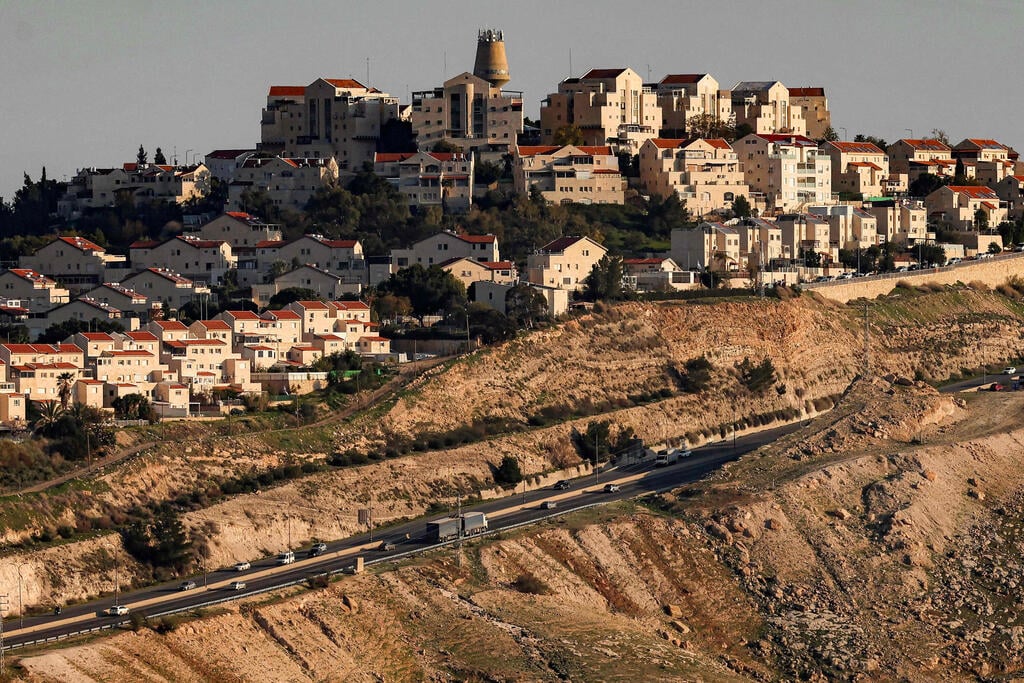
The West Bank settlement of Ma'ale Adumim
(Photo: AHMAD GHARABLI / AFP)
Ten of the 12 countries that signed Tuesday’s statement now recognize a Palestinian state. Four did so in 2025, while the others recognized one in earlier years. Denmark and Finland are the only two signatories that do not currently recognize Palestinian statehood.
A country’s absence from Tuesday’s statement does not necessarily indicate opposition to settlement trade restrictions.
Belgium and the Netherlands, for example, are not among the 12 signatories but are cited in the statement as countries that have already advanced measures on the issue.
Slovenia banned imports of settlement products in August 2025 under the government of Robert Golob. The government of Janez Janša, which took office in June, later repealed the ban.
Germany and Italy are among the most notable countries absent from Tuesday’s declaration. Both joined an August statement opposing Israel’s E1 settlement project east of Jerusalem but did not sign the latest statement on trade restrictions.
Austria, the Czech Republic, Hungary, Romania, Bulgaria, Croatia, Greece, Cyprus, Estonia, Latvia, Lithuania, Malta and Slovakia also did not sign Tuesday’s statement.
The comparison with E1 underscores the distinction. Many European governments have been willing to condemn Israeli settlement expansion, but fewer have so far committed themselves to economic measures targeting settlement trade.
The continuity between 2025 and the current initiative is also significant: Britain, France and Canada, which recognized a Palestinian state in September 2025, are now among the governments moving toward national restrictions on settlement products.
An analysis of the 12-country declaration shows several layers to the initiative.
It begins with a political assessment that Israeli settlements and their expansion, particularly the E1 project, threaten the prospects of a two-state solution. It then moves to a concrete policy proposal — restrictions on trade in settlement products — while noting that Ireland, Spain, the Netherlands, Norway and Belgium have already taken or advanced steps in that direction.
The statement invokes the New York Declaration issued last year as a broader diplomatic framework and calls on Israel to halt settlement construction, enforce the law against settler violence and investigate allegations involving Israeli security forces.
Meanwhile, it acknowledges Israel’s security concerns and condemns the Hamas-led Oct. 7, 2023, attack on Israel as “the worst antisemitic massacre since the Holocaust.”
The language appears designed to combine sharp criticism of Israeli policy with recognition of Israel’s right to defend itself, potentially broadening international support for the initiative.
Critics on the Israeli right are likely to argue that the declaration minimizes Israel’s security concerns, adopts a one-sided Palestinian narrative and politically rewards terrorism. Pro-Palestinian critics on the left, meanwhile, could argue that the initiative does not go far enough because several governments are offering commitments or considering measures rather than immediately imposing sanctions on Israel itself.
The broader significance for Israel is that the declaration is not an isolated diplomatic protest. It follows similar initiatives in recent months and reflects a growing pattern of coordinated international pressure.
Most concerning to Israeli officials is the shift from political declarations condemning settlement activity toward concrete commitments to restrict settlement trade through national legislation.
The involvement of senior political leaders also underscores that the initiative is being driven at the highest levels of government rather than being merely a technical Foreign Ministry measure.
Israel is expected to reject the declaration as interference in its internal affairs and argue that it fails to adequately account for the continuing security threats facing the country.
Officials in Jerusalem were particularly surprised by the breadth of the coalition assembled by Britain. Israeli assessments had expected the initiative to attract France and Canada but not several of the other governments that ultimately joined.
The surprise has prompted criticism of Israel’s diplomatic intelligence and its failure to identify and prevent the initiative before it took shape.

Yair Lapid
(Photo: Alex Kolomoisky)
Former prime minister and opposition leader Yair Lapid held lengthy discussions with senior British government officials last week and warned them about the potential political consequences in Israel.
“You’re helping Smotrich,” Lapid told them, referring to the far-right finance minister.
The discussions became heated, and according to Lapid, a senior British official expressed surprise that the Israeli government had done virtually nothing to prevent the sanctions.
“Of course,” Lapid replied. “Because they knew it was good for them in the election.”
Roy Fisher, head of the Foreign Trade Administration at the Economy and Industry Ministry, said Israel exported $165 billion worth of goods and services worldwide in 2025. Trade in goods and services with Britain totaled $4.4 billion.
By comparison, goods exports to Britain originating in the West Bank, East Jerusalem and the Golan Heights totaled just $45 million, Fisher said. No equivalent figures are available for services, although officials estimate that amount is small.
“I’m the last person to dismiss the declaration,” Fisher said. “It is draconian toward Israel and uses economic tools to achieve political objectives. That is wrong, improper and unacceptable in our world.”
He noted, however, that implementation would not be immediate.
“There is still time before the British declaration becomes policy — six to nine months,” Fisher said. “It’s not tomorrow morning.”
From a purely trade perspective, he said, the amount directly at stake is relatively small. The affected exports are heavily concentrated in fresh agricultural produce, particularly dates grown in the Jordan Valley.
The larger threat, Fisher said, is the potential chilling effect on businesses with no connection to settlements.
“I’m an exporter of water connectors or greenhouses, and I’m based in Tel Aviv, but my customer in England may be afraid of getting into trouble and say, ‘Why do I need this?’” Fisher said. “He doesn’t know where the Green Line is on a map.”
“That is ultimately the danger and the challenge for exports — preserving our brand and making sure people continue doing business with it,” he said.
The second challenge, Fisher said, is finding alternative markets for businesses that are directly affected.
“There are clearly entire communities that depend on these exports — date growing and other products,” he said. “My goal and that of my entire team is to find alternative markets for them. We’re already working on it.”